Preserving evidence: How OpenArchive fosters accountability and media sovereignty
This post is part of a spotlight series on the organizations defending the free Internet.
A picture may be worth a thousand words, but only if it survives. Behind every image or video is someone making a choice in real time: to document what they are seeing, preserve what others may try to deny, and take on the risks and responsibilities that come with creating archival records.
Now that technology outpaces regulation and social media is the dominant platform for news, communities sharing documentation of world events face exploitation and repression through targeting, surveillance, and media erasure or manipulation. Mobile media can disappear as quickly as it was captured because, for example, a phone gets confiscated, a platform removes it, or a company changes its content moderation policies. This media can become impossible to verify if or when metadata is stripped, potentially leading to unchecked mis- and disinformation due to media manipulation. Additionally, it can become dangerous when the wrong person can see who captured it or where it was stored.
Eyewitnesses and the media they document and preserve, often depicting potential human rights violations, are increasingly at risk of being targets of surveillance, censorship, media manipulation, doxxing, and worse. In response to these growing threats, OpenArchive first created the FLOSS Save app in 2015. Following their mission to offer people access to ethical, secure, decentralized backends, they then created their novel, custom DWeb Storage to further help communities safely preserve their documentation without having to depend on -- at best, unreliable, and, at worst, weaponized -- centralized platforms that can remove, lose, or expose sensitive data at a moment's notice.
Their vision is a future where our histories are easily preserved, securely owned, and freely accessible. OpenArchive builds towards that future through human rights-centered co-research, education/training, and tool development dedicated to the ethical collection and long-term preservation of mobile media. To achieve this, we equally prioritize privacy, usability, archival integrity, and decentralized technology to equip human rights defenders, at-risk communities, journalists, and movements worldwide with tools to preserve, verify, and act on evidence of abuses, challenging extractive technology and amplifying marginalized voices. The premise is straightforward: people should be able to easily preserve their histories safely and on their own terms.
Built for conditions documenters actually face
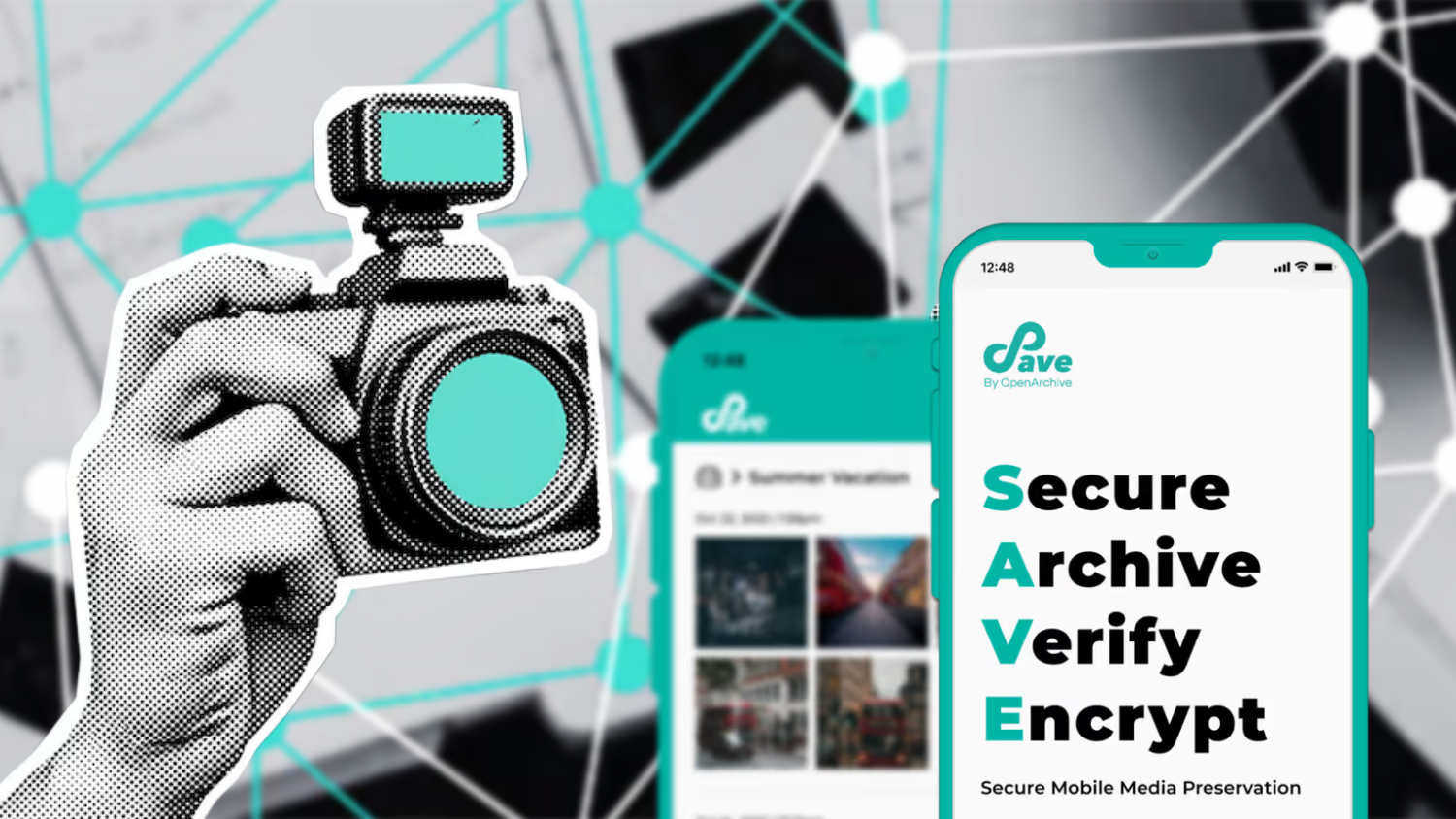
For over a decade, OpenArchive has maintained Save, their free, open source flagship mobile app that helps people securely archive, verify, and encrypt their mobile media while working under real-world constraints. Co-created with and for its users, it supports authentication via SHA256 hashes and ProofMode, encrypted transit via TLS and Tor, long-term preservation to destinations like the Internet Archive, Nextcloud, their novel DWeb P2P Storage backend (in beta), and redundancy through multi-server backup.
In practice, this work responds to urgent risks. For example, in conditions of conflict, they expedite local deployments of Save and run trainings for local archivist communities. Documenters on the ground had named phone confiscation, arrest, and internet outages as their primary risks, exactly the conditions Save is designed for.
Additionally, in one case, human rights defenders facing corporate environmental abuse had a different challenge: none of the documenters they had surveyed were using encrypted tools in their workflows, leaving them vulnerable to tracking and surveillance. In other contexts, human rights defenders also named privacy and inconsistent internet access as major barriers, underscoring how easily documentation can become vulnerable before it ever reaches an archive.
OpenArchive's work grounds those realities. Guided by the human rights-centered design methodology (co-created by OpenArchive's Executive Director, Natalie Cadranel and leading human rights experts), the team works with documenters, archivists, journalists, and advocates to understand their threats, constraints, workflows, and safety needs before designing tools around them.
Most social media platforms are optimized for attention and monetization, not for archival preservation, provenance, or community control. A centralized platform presents a single point of failure, an easy access point for censorship, targeting, link rot, or account / company shutdowns.
From camera roll to decentralized archives
Responding to this specific need, OpenArchive has built a novel p2p DWeb Storage backend for Save, now in beta. In addition to Nextcloud and the Internet Archive, it gives communities an alternative to centralized platforms, one designed around privacy, verifiability, and resilience rather than someone else's business model.
Under the hood, it uses two open source protocols: Veilid for encrypted peer-to-peer networking and anonymous connections, and Iroh for data storage, retrieval, replication, and verification. Save users can create groups, share files into repositories, and replicate media across peers, with encrypted communication and data integrity preserved throughout.
"Decentralized storage" can sound abstract. But it actually means no single company, server, or account holds the records. Copies are distributed. Access is shared among trusted peers. If one node goes down (or gets shut down), the archive survives on the others.
OpenArchive's role in the internet freedom ecosystem is protecting the chain of trust around media: who captured it, how it was handled, whether it remained intact, and whether the people behind it were put at additional risk. That chain is what makes documentation usable for journalism, legal evidence, historical memory, and accountability.
Much of this work is quiet by necessity. The communities most in need of secure archiving are often the least able to publicize their use of it.
By offering diverse and decentralized backends, Save is built for exactly that reality. When the platform shuts down the account, when the server goes offline, or when the border is closed, the record doesn't have to disappear with it.
Comments
We encourage respectful, on-topic comments. Comments that violate our Code of Conduct will be deleted. Off-topic comments may be deleted at the discretion of the moderators. Please do not comment as a way to receive support or to report bugs on a post unrelated to a release. If you are looking for support, please see our FAQ, user support forum or ways to get in touch with us.